MT3608 Step-Up Converter Module: Features, Working Principle, Circuit Diagram, and Applications
Overview
Introduction
In electronics, we often face situations where the voltage available from a battery or power source is lower than what our circuit requires. This is where a boost converter comes into play. One of the most popular modules used for this purpose is the MT3608 step-up converter.
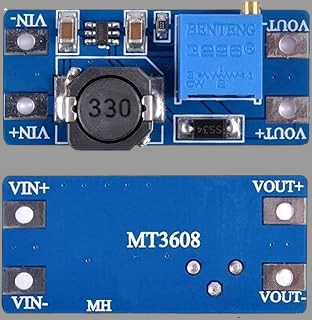
The MT3608 is a small, affordable, and efficient DC-DC converter module that can take a low input voltage and increase it to a higher, stable output voltage. Whether you are building a DIY project, working with microcontrollers, or simply need to power an electronic device from a small battery, the MT3608 is one of the most reliable options. In this guide, we will cover everything about the MT3608, including its working principle, features, pinout, specifications, advantages, applications, circuit example, and FAQs.What is MT3608?
The MT3608 is a DC-DC step-up converter, also known as a boost converter. It is built around a switching regulator IC that efficiently converts low voltage into higher voltage. For example, it can take input as low as 2V and increase it up to 28V, depending on the design and connected load.
This module is especially useful for battery-powered devices. For instance, if you have a 3.7V lithium-ion battery but need to power a device that requires 5V or 9V, the MT3608 can easily do the job.
Features of MT3608
The MT3608 comes with several features that make it highly popular in electronics projects:-
Wide Input Range: Works with 2V to 24V input.
-
Adjustable Output Voltage: Can provide 5V to 28V output.
-
High Efficiency: Up to 93% under ideal conditions.
-
Compact Size: Easy to fit in small circuits.
-
Current Capacity: Can deliver up to 2A output (with proper cooling).
-
Fast Switching: 1.2 MHz switching frequency ensures stable performance.
-
Simple Operation: No need for external components, plug and play.
MT3608 Pinout and Terminals
The module has four simple terminals:-
VIN+ → Positive input voltage
-
VIN- → Ground (negative input)
-
VOUT+ → Positive output voltage
-
VOUT- → Ground (negative output)
The output voltage is adjusted using the onboard potentiometer. Turning it clockwise increases the output voltage, and turning it counterclockwise decreases it.
How Does MT3608 Work?
The MT3608 is based on the boost converter principle. Its working can be explained in simple steps:
-
When the switch inside the IC turns ON, current flows through the inductor and stores energy in the form of a magnetic field.
-
When the switch turns OFF, the stored energy in the inductor is released and added to the input supply.
- This combined energy results in a higher voltage at the output compared to the input.
- The process repeats very quickly (over a million times per second), giving a smooth and stable higher voltage.
Technical Specifications
Here are the key specifications of the MT3608 module:| Specification | Value |
|---|---|
| Input Voltage | 2V – 24V |
| Output Voltage | 5V – 28V (adjustable) |
| Maximum Output Current | Up to 2A |
| Efficiency | Up to 93% |
| Switching Frequency | 1.2 MHz |
| Module Size | Approx. 36mm x 17mm x 14mm |
Advantages of Using MT3608
- High efficiency compared to older regulators.
- Can step up voltage from very low levels, useful for small batteries.
- Adjustable output provides flexibility.
- Small size makes it easy to use in compact projects.
- Affordable and widely available.
Limitations of MT3608
- The maximum current output decreases as output voltage increases.
- Heating may occur if used at full load continuously.
- Does not include short-circuit protection in most modules.
- Voltage adjustment requires care, as overvoltage may damage connected devices.
Applications of MT3608
The MT3608 is widely used in both DIY and professional circuits. Some common applications include:-
Boosting 3.7V lithium batteries to power 5V devices.
-
Building portable power banks.
-
Driving high-power LEDs from low-voltage sources.
-
Supplying stable power to Arduino boards and microcontrollers.
-
Solar-powered circuits, where voltage from solar panels needs boosting.
- General electronics projects where step-up voltage is required.
Example Circuit: Boosting 3.7V to 5V
Let’s take a practical example:Suppose you have a 3.7V lithium-ion battery and you want to power an Arduino board that requires 5V.
-
Connect the battery positive terminal to VIN+ and negative to VIN-.
-
Connect the Arduino 5V pin to VOUT+ and ground to VOUT-.
-
Adjust the onboard potentiometer until the output voltage reads exactly 5V using a multimeter.
Similar Modules and Alternatives
While the MT3608 is a very popular boost converter, there are other modules with similar functionality:-
XL6009: Step-up/step-down capability with higher current capacity.
-
LM2577: An older step-up regulator, larger in size.
-
TPS61088: Industrial-grade high-efficiency boost converter.
The MT3608 step-up converter module is a compact, reliable, and efficient solution for boosting low voltages into higher, usable outputs. With its adjustable output, high efficiency, and wide input range, it is suitable for a variety of applications such as powering microcontrollers, LEDs, and portable devices.
Its affordability and ease of use make it one of the most widely used DC-DC boost converter modules for both beginners and professionals. Whether you are building a DIY electronic project or looking for a stable power supply solution, the MT3608 is an excellent choice.Where to Buy
Prices may vary. Click on "Buy Now" to check current availability and pricing.
Administrator
Frequently Asked Questions
Common questions about MT3608 Step-Up Converter Module: Features, Working Principle, Circuit Diagram, and Applications. Find answers to the most frequently asked questions.
User Reviews & Comments
Share your experience with this IoT Blog. Your feedback helps our community make informed decisions!
Share Your Experience
Help others by sharing your thoughts about this IoT Blog.
Related Blogs
Explore more IoT Blogs in the same category
Li-ion Batteries for IoT: Maximizing Performance, Longevity, and Efficiency
Power Supply
Dive deep into the world of Li-ion batteries tailored for IoT applications. This detailed resource covers everything from fundamental principles to advanced optimization techniques. Understand how to choose the right battery, extend device runtime, and enhance overall system reliability, all crucial for your connected innovations.

Solar Panel: Types, Benefits, Installation Cost, and Maintenance Guide for Home & Commercial Use (2025)
Power Supply
Discover everything about solar panels in this complete guide covering types, benefits, installation cost, and maintenance tips. Whether you're planning for home or commercial use, learn how solar energy can reduce your electricity bills and promote sustainability. Ideal for beginners and property owners exploring solar power solutions in 2025.
Capacitors: Types, Working, Applications, Selection Guide & Complete Technical Overview
Power Supply
Discover everything about capacitors in this complete technical guide. Learn capacitor types, working principles, real-world applications, and how to choose the right one for your circuit. Ideal for students, engineers, and electronics enthusiasts seeking reliable, accurate information
No Reviews Yet
Be the first to share your experience with this IoT Blog!